The IRS risks noncompliance with federal records requirements
If you read the headline and thought, “Wait, the IRS might not be compliant with something,” you’re not overreacting. The Treasury Inspector General for Tax Administration (TIGTA) used that wording for a reason. The issue is federal records management, specifically the government-wide push to digitize agency records by December 2030.
TIGTA’s point is simple. The IRS has made progress, but not enough, and the pace has slowed at exactly the moment it needs to scale.
What “not complying” means here
This isn’t about the IRS failing to follow tax law. It’s about meeting federal record-management requirements, including converting historical paper records to digital format by the deadline.
TIGTA flags a risk because the IRS estimates it has roughly 1 billion pages of historical documents that ultimately need to be digitized. The IRS began with Form 709, United States Gift (and Generation-Skipping Transfer) Tax Return, and scanned 58.7 million pages from December 2023 through early July 2025, representing about 41% of the estimated Form 709 universe. That sounds impressive until you do the math. That’s still only about 6% of the IRS’s estimated 1 billion historical pages.
That’s where “at risk” comes from. The IRS is not on track to finish by December 2030 at its current pace, and TIGTA suggests the IRS could continue spending millions each year to store paper records while it tries to catch up.
The other half of the story is paper returns
The historical scanning problem is accompanied by a second, more taxpayer-facing problem: the IRS still receives large volumes of paper each year.
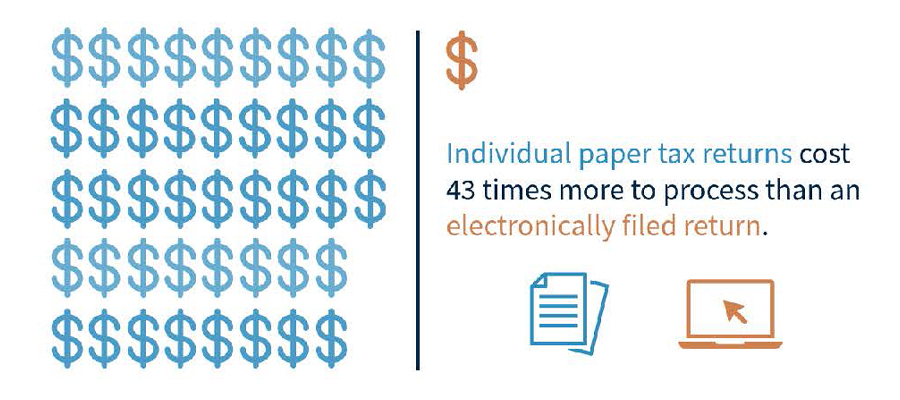
TIGTA notes the IRS processes an estimated 90 million paper documents annually (returns, correspondence and more). It also cites IRS cost estimates showing that processing individual paper tax returns costs 43 times more than processing electronically filed returns. For filing season 2025, TIGTA reports that individual paper returns accounted for about 6% of filed returns, but about 72% of processing costs.
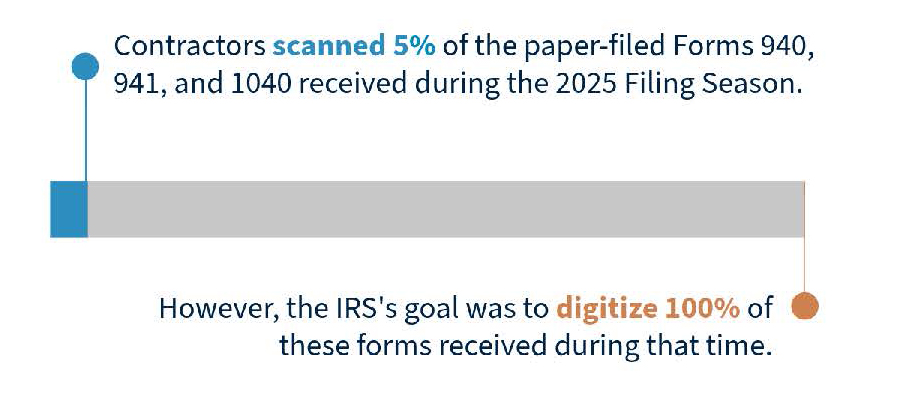
Then TIGTA gets specific. The IRS had a revised goal to digitally process all paper-filed Forms 940, 941 and 1040 by filing season 2025. As of May 2025, contractors had scanned about 517,000 of 9.8 million paper-filed Forms 940, 941 and 1040 received, just over 5% of what would’ve been needed to hit that goal.
In other words, “paperless processing” is still more of an aspiration than reality for many high-volume workflows.
Why the IRS fell behind on scanning
TIGTA points to operational disruption. As of July 2025, the office leading this work had lost 25% of its staffing. That showed up immediately in scanning volume.
Between April 5, 2025, and July 5, 2025, weekly pages scanned internally fell 91%, from 901,179 pages to 81,553 pages. TIGTA also describes a shift away from an external contract for scanning historical Forms 709 due to low volume and quality issues, resulting in a significant drop in output.
Meanwhile, the IRS’s broader direction changed, too. TIGTA reports that the IRS was directed to stop work on an in-house paperless processing system and to begin a new “zero paper initiative” (ZPI) using a phased approach. That kind of pivot can be smart in the long term, but it often slows near-term results.
What this means for returns, notices and timelines
The big takeaway for practice is not “the IRS is failing.” The paper remains a major constraint on IRS speed and cost. That hits practitioners with delayed processing and correspondence cycles for paper-filed items that can’t yet be fully modernized.
A few practical ways to use this in your workflow and client conversations:
- Set expectations early when anything will be paper-filed, including amended returns and certain elections or attachments.
- Encourage e-file whenever available and treat e-file rejections as a “fix it fast” priority to avoid falling into paper processing delays.
- Tighten documentation habits for anything that might later require substantiation, because slower digitization can mean longer retrieval timelines on the IRS side.
- Watch for shifting IRS procedures as ZPI rolls out, because process changes often show up first as new guidance or new submission pathways.
What TIGTA wants the IRS to do next
TIGTA’s recommendations focus on prioritization and execution, not finger-pointing. The report urges the IRS to evaluate options and prioritize scanning historical documents to meet the December 2030 deadline, reduce storage costs and avoid a paper backlog that becomes even harder to unwind later.
The IRS is trying to modernize while also running one of the world’s largest tax administration systems in real time. TIGTA simply says the modernization effort needs a more workable plan and sufficient capacity to complete it.
About the author(s)

NATP Staff