New 2025 Form 1040 residency checkbox explained

If you’ve started preparing 2025 individual returns, you may have noticed the IRS quietly introduced a new checkbox near the top of page 1 on Form 1040, U.S. Individual Income Tax Return:
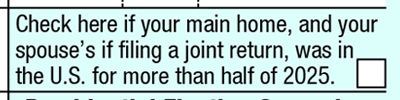
It’s easy to miss, and many software programs aren’t yet forcing an answer on this. That combination has already caught more than a few preparers off guard.
Spoiler: This new box helps the IRS gather upfront information used in determining eligibility for certain credits, especially the earned income tax credit (EIC).
What the new residency checkbox asks
The 2025 instructions for Form 1040 clearly explain the new question. If the taxpayer’s main home, and the spouse’s if filing a joint return, was in the United States for more than half of 2025, check the box. The IRS notes that answering this question helps determine eligibility for certain tax benefits, including the earned income tax credit.
This is not a citizenship question, nor is it a substantial presence test. The question focuses on the location of the taxpayer’s main home, generally where they lived most of the year, not temporary travel or short-term absences.
Why the IRS added the residency checkbox
From a compliance standpoint, the new checkbox gives the IRS an upfront data point tied to refundable credits that require the taxpayer’s main home to be in the United States for more than half the year, most notably the earned income tax credit. Instead of relying solely on downstream schedules or due diligence forms, the IRS can use this information earlier in the processing cycle to help determine credit eligibility. Failure to meet the residency requirement makes the taxpayer ineligible for the earned income tax credit for the year.
Since the IRS hasn’t clarified precisely how this checkbox will be used in processing, the new best practice is to incorporate it into your standard intake and review workflow.
Software quirks contribute to inconsistencies
Tax pros are noting the inconsistent way tax software currently handles the checkbox.
- Some programs bury the question in an input screen.
- Others do not generate a critical diagnostic when left blank.
- In some cases, completing Form 8867 may also populate the box, but that behavior varies by software.
Relying on software defaults is risky here. If the return otherwise qualifies for credits tied to U.S. residency, the checkbox should be affirmatively marked.
How to handle the residency checkbox in your workflow
The cleanest solution is to move this question out of the return and into your intake or interview process. Treat it as a standard fact-gathering item, not a software afterthought.
Many firms are adding a simple intake question such as: Did you or your spouse, if filing jointly, have your main home in the United States for more than half the year?
If the answer is no or unclear, follow up. Ask where the taxpayer lived and for how long before filing. Taking this step protects both the client and the preparer.
Joint returns require extra attention here
Remember, for joint returns, the residency checkbox applies to both spouses. The Form 1040 instructions require that the taxpayer’s main home and the spouse’s main home be in the United States for more than half the year to check the box.
If either spouse’s main home was outside the United States for more than half the year, the box should not be checked, even if the other spouse meets the requirement. This applies regardless of whether the couple files jointly or otherwise qualifies for credits based on income or dependents.
This nuance can be easy to miss and is another reason not to rely on software defaults or assumptions.
What to do about returns already filed
If you discover the residency checkbox was missed on a filed return, the impact depends on the return. Returns that do not claim credits tied to U.S. residency are unlikely to be affected.
For returns claiming the earned income tax credit or similar child-related credits, there is no clear guidance yet on how the IRS will treat a missing or inconsistent checkbox. At this point, the practical approach is to simply monitor the return and watch for any IRS correspondence; do not amend solely to address the checkbox, unless other changes are needed.
The bottom line
The new 2025 Form 1040 residency checkbox looks minor, but it plays a meaningful role in credit eligibility and IRS screening. Making it a standard intake question and verifying the answer before e-filing is the best way to avoid surprises.
NATP continues to track form changes like this and explain their real-world impact for tax professionals.
About the author(s)

NATP Staff