IRS audits are declining, so what’s next?

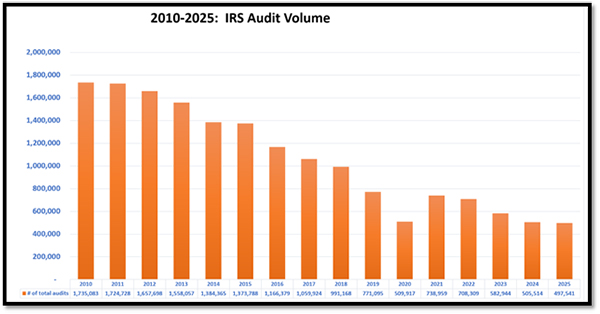
For more than 15 years, IRS audit rates have been steadily declining, and 2025 marked a historic low. The IRS completed 497,541 audits that year, less than 30% of the annual totals seen during 2010-2012, when audits averaged 1.7 million per year. Audit volume has not been this low in modern history, and the trend is expected to continue.
But what does this actually mean for tax professionals?
Audit decline vs. voluntary compliance
Despite shrinking audit activity, voluntary compliance has remained remarkably stable. The IRS reports an 85% voluntary compliance rate on 2022 returns, a figure that has held steady for roughly 25 years. This suggests that audits themselves are only one piece of the compliance ecosystem.
Other enforcement tools, including collection efforts, nonfiler programs and automated matching systems like CP2000, continue to play significant roles in influencing taxpayer behavior.
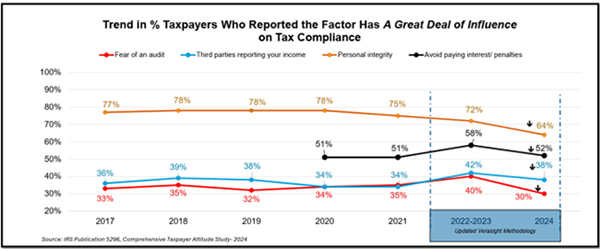
However, the trend is not without concern. Findings from the 2024 IRS Comprehensive Taxpayer Attitude Study show a noticeable drop in taxpayers’ fear of being audited as a motivator for accurate filing. Taxpayers clearly recognize how rare audits have become.
Mail audits dominate
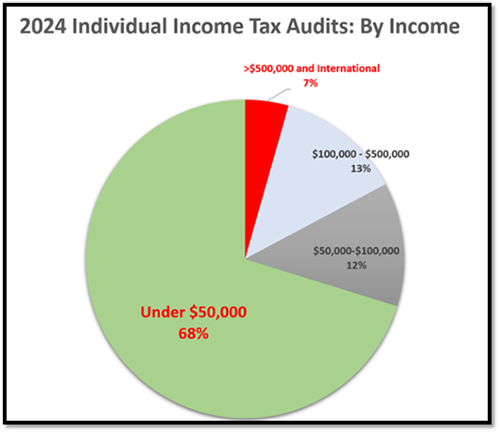
Contrary to the popular image of face-to-face examinations, about 80% of IRS audits now occur by mail, focusing primarily on refundable credit issues such as the earned income tax credit. In 2024, 68% of individual audits were conducted on taxpayers earning under $50,000.
Field audits are rare, but have a high impact
Comprehensive field audits, conducted by IRS revenue agents examining complex issues in depth, have become extremely limited. These audits typically:
- Target businesses, higher income individuals and complex transactions
- Take over a year to complete
- Result in substantial assessments
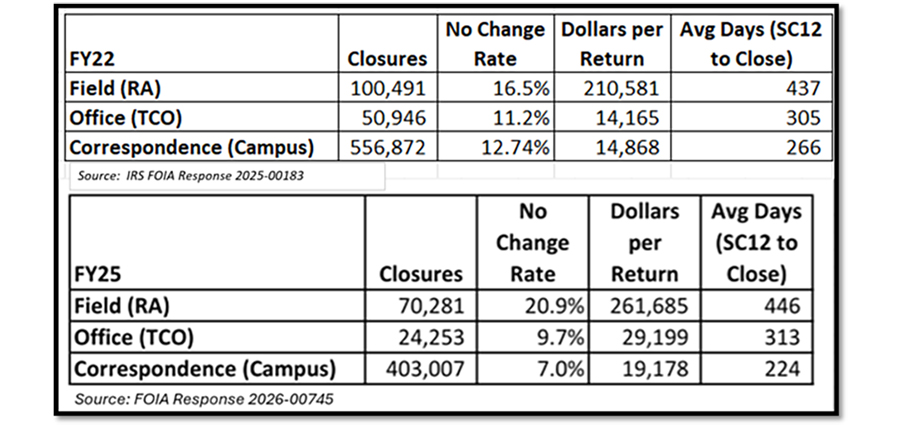
Recent IRS data from 2022 and 2025 underscores how few field audits are being completed relative to historical norms.
Are IRS audits going away?
Short answer: No, but they will remain limited for the near future.
IRS enforcement capacity has been squeezed by:
- Budget reductions
- Rescission of large portions of the 2022 Inflation Reduction Act enforcement funding
- Significant workforce losses
In 2025, staffing dropped 37% in Small Business/Self Employed (SB/SE) and 25% in Large Business & International (LB&I). These divisions conduct nearly all IRS field audits and require years of experience to develop auditors capable of handling complex examinations. Fewer auditors simply means fewer audits.
Data will drive the future of audit selection
While audit volume may be low, the IRS is not retreating from enforcement. Instead, it is becoming more targeted.
Advanced data analytics are increasingly used to:
- Identify high-risk areas of noncompliance
- Focus on high wealth taxpayers and sophisticated transactions
- Prioritize areas such as cryptocurrency, partnerships and emerging tax strategies
This shift means that although fewer taxpayers will be audited overall, those selected will likely represent higher impact cases.
Small business audits will return first
Among field audits, small business audits remain the most common. With over 36 million small businesses, many of which involve cash-intensive operations, this segment represents a significant, historically noncompliant group. IRS tax gap data shows a 55% misreporting rate among the most cash intensive small businesses.
Because these audits require less specialized experience, they are likely to rebound sooner once IRS hiring ramps up again.
So, will we see more or fewer audits?
Expect fewer audits overall in 2026, especially on the field audit side. But this does not signal a collapse of audit enforcement.
The IRS will continue to rely heavily on:
- High volume correspondence audits
- Refund holds
- Targeted enforcement campaigns driven by analytics
Field audits, though limited, will focus on taxpayers and issues with the highest expected yield.
Your next steps as a tax pro
Tax practitioners will continue to play a critical role in representing clients through all types of audits. With more targeted examinations, tax pros must be ready to navigate:
- More complex audit issues
- Data driven IRS challenge areas
- Longer, deeper field audits when they do occur
- Heightened scrutiny on high-risk taxpayers and transactions
Though audit volume is low, the impact of audits on a client selected for audit is significant, and clients will rely on tax professionals more than ever to advocate effectively and manage increasingly complex IRS interactions.
About the author(s)

Jim Buttonow, CPA, CITP, AATPR