How to manage IRS phone access challenges

Tax professionals regularly need direct contact with the IRS to obtain account information, address notices, resolve account issues and move client matters forward. In practice, however, reaching a live assistor can be difficult, particularly in the weeks following the April filing deadline.
As of May 2026, many practitioners report extended hold times and “courtesy disconnects” when contacting the IRS. The primary phone resource for tax pros is the Practitioner Priority Service hotline (PPS). PPS remains available on weekdays from 7 a.m. to 7 p.m. local time with Alaska and Hawaii following Pacific time, and 8 a.m. to 8 p.m. local time for Puerto Rico. PPS is an IRS “accounts management” hotline that tax pros can use to obtain client information, including payments, return filing information and transcripts.
There are many other IRS hotlines. These hotlines are generally reserved for specific issues and compliance functions. They are referred to as the IRS’s “non-accounts management” hotlines.
Practitioners working cases that require contact with non-accounts management functions (collection, the Taxpayer Protection Program or the Taxpayer Advocate Service) may encounter even greater access challenges. Historical service data and practitioner experience both suggest that these lines can be harder to reach than standard accounts management channels, making advance preparation and triage especially important. For example, in tax season 2025, non-accounts management hotlines had much longer wait times and very low live connection rates.
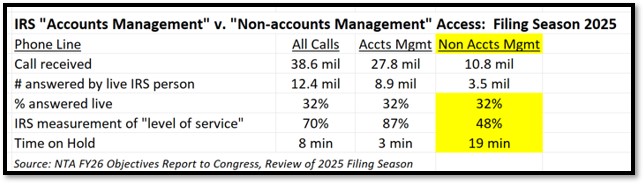
Fortunately, most IRS contacts involve accounts management hotlines. Even so, post-tax-season access is difficult across all lines. Using best practices, limiting unnecessary calls and relying on online tools can make IRS interactions more efficient.
Best practices for IRS interactions
Even highly proactive firms will occasionally need IRS involvement for matters such as obtaining client information, identity verification, refund holds, compliance issues, installment agreement questions and notice resolution.
For tax professionals who need to engage with the IRS, the following six practices are often the most effective in both contacting the IRS and avoiding unnecessary IRS phone calls.
1. Call as soon as the applicable line opens and use the callback feature
For PPS matters, that generally means calling as soon as the line opens, often at 7 a.m. local time. For specialized functions, confirm the operating window in advance and place the call at the start of that window whenever possible.
Firms may not always need an enrolled agent or CPA when the goal is simply to receive authorized access to a client’s IRS account information. Firms may also designate noncredentialed staff on Form 8821, Tax Information Authorization, to receive IRS tax information, where appropriate and in line with IRS authorization rules.
Tax pros can also use the IRS “callback feature” to potentially eliminate unnecessary hold times. When wait times are high, some key IRS phone lines offer a callback option so tax pros don’t have to stay on hold. When available, the callback system provides an estimated return call time and attempts to reconnect with the practitioner during that window.
2. Use transcripts strategically to avoid unnecessary calls and issues
In many cases, utilizing a transcript can avoid a phone call. IRS transcripts can confirm filing, payment and account activity. Transcripts can also be used to avoid IRS issues by helping file accurate returns. For example, the wage and income transcripts can be used proactively to reconcile income data before the IRS issues a discrepancy notice, such as a CP2000 underreporter notice.
3. Use the Online Payment Agreement
Millions of taxpayers owe back taxes to the IRS and need a payment plan. Most individual taxpayers who owe a balance and cannot pay in full may qualify to use the IRS’s Online Payment Agreement (OPA) tool to set up a payment plan. In fact, a large share of new payment plans are now set up using the OPA rather than by phone or mail. Tax pros, with a filed Form 2848, Power of Attorney and Declaration of Representative, can use OPA to set up client payment plans if the client owes less than $50,000 or less in combined tax, penalties and interest. Using OPA not only avoids a phone call to the IRS but also results in lower fees to set up the payment plan with the IRS.
4. File authorizations in advance to gain quick access to your client’s account
Access to the client’s information, via both PPS and transcripts, requires that an authorization be on file with the IRS’s Centralized Authorization File (CAF) unit. If you cannot complete individual authorizations online (using Tax Pro and Taxpayer online accounts), you may need to wait additional time before gaining access to the client’s account information.
Firms can reduce PPS call time and be in a position to proactively pull transcripts via the IRS e-Services Transcript Delivery System (TDS), if they file their authorization in advance. Many tax pros and firms file Forms 8821 annually for their clients to provide quick access to their accounts and transcripts.
5. Check the IRS operations dashboard before calling
If the issue involves general processing timeframes for a filed return, correspondence or a submitted authorization, the IRS processing status page may provide the answer without requiring phone contact. Reviewing published processing timeframes first can help practitioners determine whether follow-up is warranted or whether additional time should be allowed. Tax pros can check the IRS processing status page before calling.
6. Maximize each successful connection
Practitioner Priority Service generally allows multiple client issues to be addressed in a single call. In fact, PPS representatives can take up to five clients per call. To make the most of hold time, firms should prepare in advance to resolve multiple client matters with the IRS representative.
IRS contact efficiency takeaway
IRS phone access remains a meaningful operational constraint for tax practices, particularly during peak and post-deadline periods. A disciplined approach, combining early calling, transcript analysis, OPA use, advance authorization filing, published IRS processing timelines and deliberate call preparation, can improve efficiency, reduce unnecessary phone contact and support more effective client service.
About the author(s)

Jim Buttonow, CPA, CITP, AATPR