EA exam day essentials from check-in to your final score

Every tax season, someone in the office says, "This is the year I go for my EA." Then clients start calling, and the idea slides quietly into next year. If you're ready to stop talking about it, here's the good news. The enrolled agent (EA) exam is demanding, but it isn't mysterious. Here's what you'll face before and during test day.
Know what you’re working towards
EAs hold the highest designation the IRS offers. Like CPAs and attorneys, they can represent any taxpayer on any tax matter before any IRS office. The path runs through the Special Enrollment Examination (SEE). You'll need a preparer tax identification number (PTIN) to schedule. After you pass all three parts, you'll apply for enrollment and must be able to clear a suitability check of your personal tax compliance and criminal background.
Three parts, three personalities
Part 1 covers preparing taxes for individuals, including Form 1040, U.S. Individual Income Tax Return. For most, this is the world you already know. That familiarity is exactly why overconfidence trips people up. Part 2 tackles businesses, including partnerships, corporations, trusts and depreciation, and many candidates call it the steepest climb. Part 3 tests representation, practices and procedures, with Circular 230 and ethics at its core.
You can take the parts in any order and on separate days. Each one has 100 questions, but only 85 count toward your score. The other 15 are experimental, and you won't know which ones they are, so treat every question like it matters.
Test center or home office
PSI now administers the SEE, and domestic candidates can choose a PSI test center or a remote, live-proctored exam. Remote testing saves you a commute, but it isn't casual. You'll need a private room with a door, a clear desk, one monitor and a computer that runs PSI's proctoring software. A proctor reviews a video scan of your space at check-in and watches it throughout. Glancing away, reading aloud or leaving the camera's view can pause or end your exam, so run PSI's system check well before test day.
Scheduling, cost and the fine print
Each part costs $317, paid when you schedule, and the fee is generally nonrefundable. Cancel or reschedule at least 48 hours ahead and you're in the clear. Wait longer, and you'll pay a new full fee. Arrive 30 minutes late, and you forfeit it entirely.
The current domestic testing window runs from July 1, 2026, through Feb. 28, 2027. The exam is generally unavailable in March and April while it is updated for new law. You can take each exam part up to four times during a testing window. Once you pass a part, you have three years from that date to pass the remaining parts for that score to count toward EA enrollment. Bring one unexpired government photo ID with a signature, and make sure your name matches your PSI profile exactly.
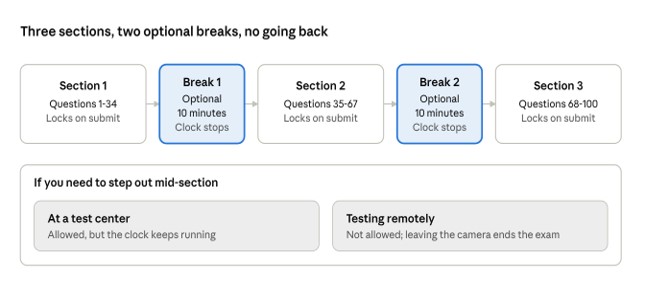
EA exam day · three sections, two optional breaks
A break ends after 10 minutes or when you choose to resume, whichever comes first. Gleim suggests about 1½ minutes per question. At that pace, you'd have roughly 60 minutes of review time across the exam, before the individual sections lock.
Test day, start to finish
Plan on a four-hour appointment. That includes 3½ hours of testing time plus a tutorial, a short survey and two optional 10-minute breaks that split the exam into three sections. If testing at a center, arrive at least 30 minutes before your scheduled appointment for check-in and security. Expect an additional ID and security check after each break. The exam is closed book. Test centers supply scratch paper and pencils, while remote testers use an on-screen whiteboard instead. Both have access to an on-screen calculator.
Scoring under the new system
Scores now run on a scale from 200 to 800, and 500 or higher passes. You'll see a pass or fail message on screen as soon as you finish, followed by an emailed score report. Pass, and the report shows a passing designation and diagnostic information, but no numerical score. Fall short, and you'll see your scaled score plus diagnostic feedback pointing you toward the topics to revisit.
Prepare like a professional
Study the reasoning behind each rule, not just the answer. Work through the IRS sample questions and lean on IRS publications alongside your review course. Take timed practice exams, because pacing matters. Most important, book your date. A deadline turns "someday" into a plan.
The EA exam at a glance
Part 1 has the lowest pass rate, while Part 2 asks for the most study time. Here's how the three parts compare.
| Part | Focus | Questions (scored) | Testing time | 2024-2025 pass rate | Suggested study time |
|---|---|---|---|---|---|
| Part 1 | Individuals | 100 (85) | 3½ hours | 58% | 80-90 hours |
| Part 2 | Businesses | 100 (85) | 3½ hours | 71% | 110-120 hours |
| Part 3 | Representation, practices and procedures | 100 (85) | 3½ hours | 70% | 45-55 hours |
Pass rates and study-time estimates come from the 2026 Enrolled Agent Exam Guide by Gleim, NATP's preferred EA review provider. Gleim recommends at least 10 hours of study a week, a pace that puts one part within reach in two to three months and all three in about a year.
NATP members receive access to Part 1 of Gleim’s EA exam review course with membership, along with a significant discount on Parts 2 and 3.
Once you earn your designation, NATP offers continuing education to help you maintain it, stay current on changing tax laws and continue building your skills. Members have access to resources, industry updates and a community of tax professionals who understand the work you do.
About the author(s)

NATP Staff